This is an engineering analysis of a publicly documented weapon system based on parts lists released by the Ukrainian government and other open sources. It is not a build guide and contains no information not already in the public domain.
The most symbolic drone of the Ukraine War is the Geran-2/Shahed-136 (hereafter referred to as Geran). This article will analyze some of the hardware and try to derive both a realistic cost and a realistic architectural diagram of the Geran.
This article is meant to be a kind of “mythbusting” and explainer article on the Geran. I read too much misinformation and disinformation on these drones online. This goes in two directions – either the Geran is a “cheap superweapon that has the weak westerners trembling” or is a “piece of junk that is as dangerous for launch crews as the enemy”. Of course, I’ll aim to show the truth is in the middle.
What is the Geran?
The Geran is a relatively cheap one-way attack drone. It’s launched with a rocket-assisted sled and then uses a small 550cc gasoline aircraft engine to fly over a very long distance (up to ~2500km) to a predefined target location and deliver 50-90kg of explosives. The Geran is a versatile platform – the base version has no cameras or advanced jamming/sensors, but specialized versions add them, with some versions even adding an anti-aircraft rocket launcher to fight anti-drone drones. This blog post will focus on the base version.
The benefits of such a platform are evident – it shares the role with a cruise missile, but with the following benefits:
- Gasoline engines are much more energy efficient than rocket engines – the Geran can fly the same distance with a much lower weight dedicated to fuel and without extremely intricate hydraulic systems.
- Gasoline engines are much cheaper than rocket engines for the same distance. Overall, the entire Geran is much cheaper – a Geran has the unit cost of ~30 000$, while an Iskander has the unit cost of ~3 000 000$ -> you can launch 100x Gerans for each Iskander.
- Due to the small size and simplicity, unlike the Iskander or Kinzhal missiles, which require either a specialized truck or aircraft and large infrastructure to arm and carry them, a Geran can be (and usually is) launched from a pickup truck.
- This will be discussed more in detail later, but because the Geran is much simpler, both electrically and mechanically, it can be (and is) assembled by unskilled labor (usually children or human-trafficked Africans).
- The material requirements are much lower – where a missile requires heat-resistant materials and aerospace-grade components, a Geran is made out of 90-99% commercial/industrial components (depending on the variant).
- The low unit cost and mass-production means that the costs of shooting down a Geran are often higher than the system itself – even when shot down, the defender loses more resources than the attacker, not to mention the high level of alertness and detection/tracking/interception systems required to be constantly operational, leading to manpower and equipment exhaustion.
- Missiles cannot be stored for a long time without fuel degradation, or if the fuel is stored separately, they cannot launch without a long and vulnerable fueling procedure. The Geran can be empty and someone can fill it up with fuel in a Coca Cola bottle.
However, this also has some critical disadvantages:
- The Geran flies much slower and lower than a missile, making it much easier to shoot down.
- The Geran carries an explosive load 1/10th of an Iskander (though still far more than enough to destroy any vehicle it hits).
- Gerans are often made to a lower quality and have a high failure rate due to the unsuitable electronic and mechanical design.
- Due to the relatively simple guidance electronics, Gerans often miss or are jammed and steered to explode away from their target.
Thus, the Geran is not a superweapon – it’s just a weapon, a tool, one of many.
What do you need to make one?
Luckily, my favorite source – the Ukrainian government itself – has released partial parts lists of downed Gerans. These are primarily meant to encourage allies to enforce sanctions by showing that the majority of components are US/European in origin, but from these parts lists, as well as some aerospace engineering knowledge, the architecture and a full parts list (by combining many separate ones) can be inferred. Note that none of this is confirmed, as I do not have a Geran, and I really hope I don’t find myself at the pointy end of one.
Let’s be the Russian military industrial complex and let’s design this thing. We first need to define our requirements. Our drone should:
- Be cheaper than the cheapest plausible interceptor. When a soldier shoots a Stinger at a Geran, Ukraine loses. When a soldier doesn’t shoot a Stinger and the Geran hits a Patriot, Ukraine loses a lot more. Given that most major interceptors cost ~100k+, if a Geran is a fraction of that cost, we win, as long as we keep shooting Gerans, we win.
- Have a long range – this is both practical and surprisingly cost-saving. An aircraft-launched or truck-launched missile is a big, nice target for the enemy, especially near the front. However, a Geran launched from a pickup truck in any random field 1000km away from the front is never going to be a target. Additionally, this forces autonomous navigation, which doesn’t require a skilled operator and extensive communications networks that can support video bandwidths.
- Be mass-producible – it needs to be easy and relatively cheap to build. Sometimes, a slightly more expensive design can be much more time-consuming. We need volume, not just low cost.
- Have a useful payload – we’ll be targeting HIMARS, electrical substations, military outposts – this needs about 50-100kg of explosives to do real damage.
- Operate in a contested EW environment – we’re fighting against the combined Western military-industrial complex. They’ll be jamming and spoofing every frequency and every communications protocol – we need redundant guidance sources for this.
- Easy to maintain, deploy, and operate – our brightest minds are now building “B2B SaaS AI Blockchain apps” in Western Europe. The guys on the front are those who really had no other options in life. The thing needs to be as simple as possible.
- Manufacturing and testing should be simple and geographically dispersible. A missile factory is the best target you could imagine – a highly-explosive warehouse with irreplaceable world-class industrial machinery. Our drone should be easy to build and test by anyone, anywhere.
- Buildable from commodity silicon. No parts that can be easily sanctioned.
- Upgradeable and flexible. The battlefield is very dynamic and what worked today won’t work tomorrow. A platform that can tolerate things placed on it is a good platform.
Architecture and Design
The design you’d end up with those requirements is basically the Geran design. It appears to be highly standardized and consistent from the original Shahed-136. Russian capabilities have upgraded it, but not replaced any major architectural components. The following is my best attempt at reverse-engineering the architecture (information mine, SVG generated by Claude):
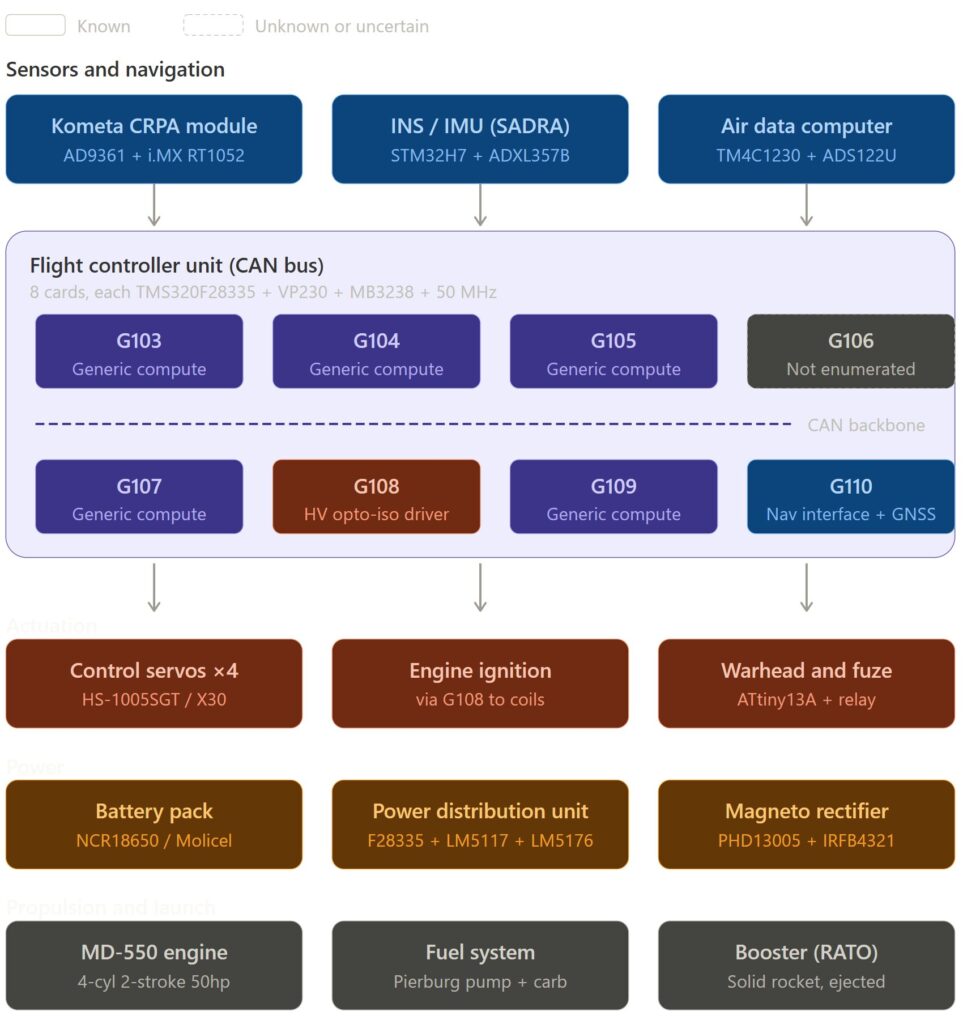
This architecture is very simple and logical, both on the architecture and PCB level. Every drone has these blocks. Everything is organized into modules that are interchangeable, modifiable, and communicate using common industrial protocols (RS-485 or CAN bus). What’s notable here is that every single one of these components (except for the engine, rocket, and AD9361) can be found inside any modern factory system or car. The battery pack is a ridiculously common commercial format. The TI TMS320F28335 and TM4C1230 are used in many industrial motor controllers. The STM32H7 and i.MX RT1052 are high-performance commodity microcontrollers that you’d find in something like a smart washing machine. These parts are difficult to sanction because they’re used in everything a modern economy needs. There’s likely at least one of those microcontrollers in your room. Note that even though these are all commercial/industrial parts, they’re very high quality parts.
Inter-Board Communication
The architecture is quite early-2000s general aviation – it’s federated (so lots of small, separate modules rather than one central module) and connected through CAN bus. CAN is the dominant communications protocol in cars, and from the early 2000s, it’s gained a lot of ground in aircraft. It’s a simple and rugged bus, but it has the additional benefit of being very widely used and highly developed – any designer knows about it, the quirks are all known, and the data rate is decently high (at 1Mbps or 125KB/s) to support most distributed systems (though video streaming is impossible).
This also allows them to use very cheap and very available CAN bus transceiver ICs – you can’t sanction these, because every car requires tens or hundreds of them. Had they been using something more traditional to military aviation like MIL-STD-1553 (which the USSR also used extensively), that would’ve been much easier to sanction. Additionally, since almost every mid-range and high-end microcontroller supports CAN bus, it’s trivially easy to implement it in a design.
The G-Boards
The G-Board architecture is a standard, generic architecture. From images, the boards appear to be stacked with board-to-board connectors together with the power distribution unit and flight controller. In the original Iranian Shahed, this stack appears to have been in the nose, while in the 90kg warhead Russian Geran, this was moved to the back and a ballast was added (https://militarnyi.com/en/news/ukrainian-defense-intelligence-russians-significantly-modernized-shahed-and-gerbera-drones/). This is interesting because it shows that the original architecture is quite modular and modifiable.
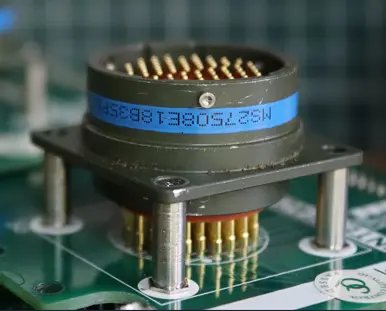
The G-boards appear to have a MS27508E18B35P connector (MIL-DTL-38999 type) to carry out all of the communications, power, and control signals between the flight stack and the rest of the drone. This is very normal. That’s a surprisingly military-spec connector for such a drone, but it’s nevertheless widely commercially available – that connector type is quite standard in electronic equipment for harsh environments.
However, this architecture has a major weakness that the need to put a ballast (dead weight, likely carrying a notable range decrease) also demonstrates the weakness of this architecture – it takes up a lot of space. The early 2000s trend of board distribution has been widely replaced by more centralized computing. As FPGAs and microprocessors have put immense amounts of computing in tiny packages, as well as many of the G-boards’ components being quite old and large, it is possible to condense all of the G-boards into one, while having much higher performance. Even the FPGA* used in the CRP antenna has more than enough power to run all of the processing on the Geran with a lot more to spare.
Nevertheless, the G-board architecture is likely the best that they can reasonably do within their limitations, and it’s also interesting because it shows the limited role China plays. It’s likely that these boards are manufactured and populated on-site in Russia, rather than in China. China has a huge number of world-class PCB manufacturers that trivially produce and populate the types of advanced PCBs the Geran could use – but they don’t seem to be present here. For hand-assembly by unskilled workers, the G-board design is the most suitable way of doing it, because practically all of it can be hand-assembled from base parts. In this case, while engineering intuition might suggest a small, lean main PCB with a single processor, in the context of the state of the Russian military-industrial complex, they seem to have sacrificed performance in order to win in manufacturability and simplicity. A complex board would require professional technicians and high-tech production and testing machinery of the type Russia is severely struggling to obtain and maintain.
*Note that some smaller microcontrollers and auxiliary components (like the FPGA) were omitted from the diagram – the Geran includes an additional STM32F405 in the INS/IMU board. The FPGA is really interesting (discussed more in my previous blog post at https://snikolaj.com/2025/05/21/chinese-components-in-russian-military-drones/).
Design Stability
The goal of design simplicity and stability is also supported by the fact that the component choice is actually rather expensive. The parts by TI and ADI in particular have Chinese clone variants that cost a fraction of the price. It’s likely that they don’t want to change the design and take risks. It seems that even though low cost was a priority, it’s not the absolute lowest cost. Let’s just take a random example:
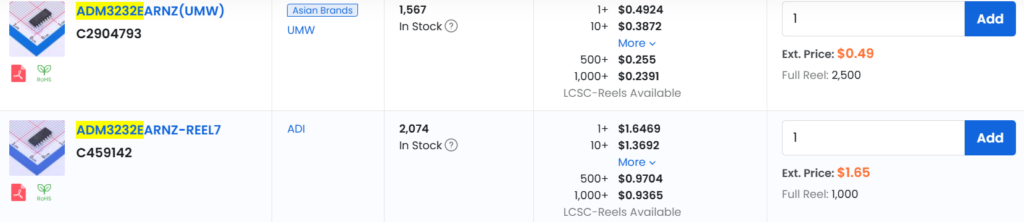
The ADM3232E by Analog Devices has a direct Chinese clone that costs less than a third of the price. I don’t know about clone’s quality, but I doubt they’re practically much different for what they’d be used for – the Chinese one is designed as a drop-in replacement for the US one. But they’re not replacing them with the Chinese clone. This would also hint at China’s limited role, as Russia is likely paying a large markup on the ADI and TI parts given sanctions, but are not replacing them with easily-available and cheaper Chinese parts.
Additionally, the design is kept very stable from the original. One interesting thing about the parts is that they’re not very good parts – but they are very available parts. Many are essentially obsolete, but maintain a strong presence through their use in existing, older designs, and are exactly the type of part you’d find stocked in a random Hong Kong warehouse in million-quantities. You’d never use something like a TPS5430 in a modern design, as there are alternatives that are better in practically every way, while costing much less. Here are some random examples:
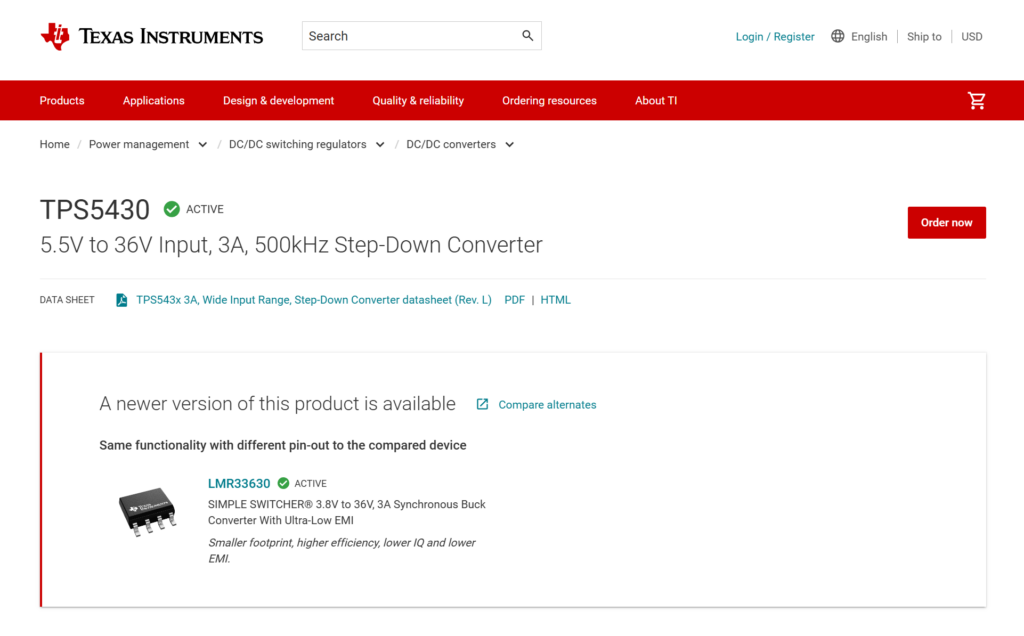
(TI telling you to use the newer version)
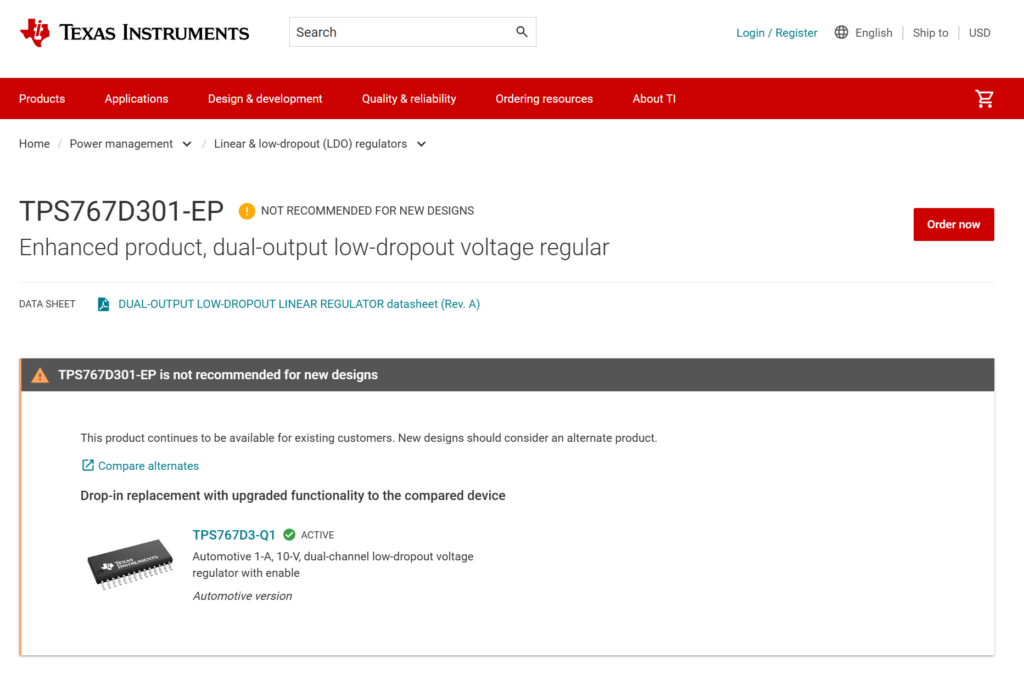
(TI strongly telling you to use the newer version)
These parts were high-end at one point, but have been long superseded. However, they are not being replaced by better parts – rather, they’re keeping these strained supply chains going. It’s likely that a redesign and requalification would cost more or interrupt manufacturing more than the cost savings would – the relevant Russian ministries naturally have more data on this, so they probably made a few difficult calls.
Notable Changes
Nevertheless, there are two very notable changes. I discuss these more in the article I linked previously, but Russians seem to be replacing the highest-end parts with Chinese alternatives. From what I’ve been able to find, these alternatives are in most cases better than the originals, and they’re happening at the higher-end parts.
The first type of replacement is in the CRPA board. This is by far the highest-complexity board on the whole drone and the most susceptible to sanctions. It went from an AD9361 + Xilinx FPGA design to one with mostly Chinese domestic manufacturers. The reason why this board is most susceptible is because these higher-end parts aren’t generic commercial/industrial parts. The AD9361 is limited to high-end telecommunications (which was already under Western sanctions), while the ultra-high-end Xilinx FPGA used is also limited to very specific tasks such as supercomputers, datacenters, or advanced research. These parts are used in low quantities and tracked much more closely. The replacement of the Western components with Chinese ones was also followed by significant capability increases. It’s likely that the qualification cost of the Xilinx was sunk anyways – if they’re redesigning, why not make it better.
The second type of change is the microcontroller replacement – STM32s are becoming GD32s (in the case of STM32F405, STM32F103, STM32G071). The GD32 series is made by GigaDevice, one of the companies that China prioritizes as leading in the replacement of Western components. GigaDevice was long a strong player in commodity embedded flash memory, but they were one of the companies that rode the wave of the COVID shock in China. I’ll go on this tangent a bit here because it’s relevant to China’s trajectory in the electronics market and hints at how China would be a far stronger opponent than Russia.
STMicroelectronics makes a lot of electronics, but they’re most notable for their STM32 microcontrollers, which they’re global leaders at. Because of this, the world grew to love STM32 microcontrollers, which are used in lots of devices. They’re especially dominant in mid-range devices, which are the exact type China needed during the late 2010s and early 2020s, as their industry was advancing its technology at a rapid pace. However, because of this, when COVID hit, STMicroelectronics found themselves with an acute supply shortage and immense demand. STMicroelectronics sharply increased prices and had no stock of many models for months, particularly the exact types Chinese manufacturers needed. Before this, some Chinese chip manufacturers had cloned the STM32s, but now as demand for them skyrocketed, the Chinese clones had to fill in the gap. These Chinese manufacturers used something that would be a weakness to anyone else to their advantage – they couldn’t copy the exact transistors of the microcontroller, but they could make compatible ones. So, given that STM32s are not really black magic, they made compatible clones with their own specialties and with 10+ years of chip design advances behind them. This created a very interesting market that had the following features:
- Clones were pin-compatible and code-compatible. This meant that the code you had written and the circuit boards you had manufactured would work with almost no changes with the clones.
- The clones made by different companies used those companies’ specialties. GigaDevice, for example, used their skills in manufacturing flash to put separate high-speed flash dies in their microcontrollers, thus making them easier to manufacture, cheaper, faster, and with a lot more storage. WCH used their skills with peripherals to put peripheral features in microcontrollers that STMicroelectronics put in their much higher-end microcontrollers or not at all.
- Because most of the design had already been done by STMicroelectronics and the supply chain was tighter, these clones were usually cheaper. Some of them used RISC-V instead of Arm, which meant that they didn’t have to pay license fees. Additionally, because they had a fixed high demand, they could manufacture at scale, knowing that they would sell all of them.
Nowadays, STM32 has bounced back, but there’s still a huge push in China to use their “domestic microcontrollers”. Additionally, because of market competition, STM32s are much cheaper in China than anywhere else in the world. The takeaway from this is that supply constraints can be harnessed positively to encourage innovation and come out stronger because of it – Russia just doesn’t do that.
Design Breakdown
This section will comment on the design of the boards themselves and my best guess on their purpose and how they fit within the design, together with some comments.
G-boards
These form the flight computer. They’re eight cards on a shared CAN bus, every one with the same recipe (F28335 DSP + VP230 CAN transceiver + MB3238 RS-232 + PS767D301 dual LDO + 50 MHz oscillator + tantalum bulk cap). The differences are what’s bolted onto each card beyond that recipe:
- G108 is the one fully decodable special-purpose card: AUIRF4905S P-MOSFET + H11G1 high-voltage opto + LM234 current source + LM258 op-amp = opto-isolated high-side power switch. Most likely engine ignition coil drive, possibly fuel solenoid or pyro, but the topology is unambiguous.
- G110 is the navigation interface card: F28335 + HCT04 logic + the u-blox NEO-M9N GNSS receiver + (in newer drones) an STM32F446 Cortex-M4 alongside the DSP. It links GNSS and the rest of the CAN bus.
- G103, G104, G105, G107, G109 are five mostly-identical compute cards. They almost certainly run different firmware doing different things – servo control, throttle, telemetry, engine sensor processing, booster separation logic – but the BOMs alone don’t tell you which is which. You’d need flash dumps to distinguish them.
- G106 shows up as a board reference in the part lists but only ever has a single tantalum capacitor enumerated. Either a passthrough/breakout board, a placeholder slot, or just incomplete teardown documentation.
If I had to guess, given that the boards seem to have a CONNFLY DB-9 connector on the side, the MB3238s + DB-9 connectors are for programming, while the VP230s are for inter-board communication.
Smart sensor blocks
Each is a self-contained subsystem with its own MCU and its own GNSS receiver, talking to the flight computer through either RS-232 or CAN.
The Kometa CRPA is not part of the original – it post-dates the original Iranian design and was integrated by VNIIR-Progress for Russian-built Geran-2s. It runs its own anti-jam beamforming on an i.MX RT1052 and feeds corrected position to the FCU. This is a remarkably powerful capability for such a cheap drone and may cost as much as the rest of the electronics combined – or more.
The INS hosts its own u-blox NEO-M8/M9/M10 as a redundant GNSS source independent of the CRPA path. The Air Data Computer is a small TM4C1230-based card that digitizes pitot/static pressure with a 24-bit ADS122U ADC.
Actuation
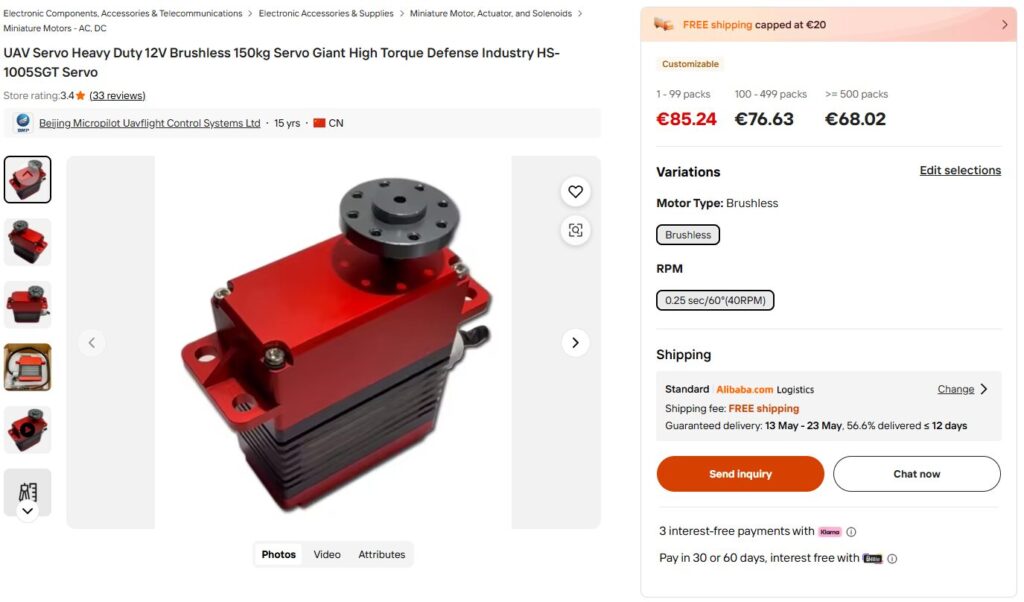
The flaps on the wings need to move somehow, and they achieve this through hobby-grade servos with their own STM32F030 + AS5600 + EG2134 driver inside each unit. Engine ignition is driven from G108. The warhead initiation block uses an ATtiny13A microcontroller and an HFD4/5-S relay to gate the detonator – extremely simple, which is what you want for a safe-arm-fire chain.
Power generation
Battery pack (NCR18650 cells, Molicel B in newer drones) sits on the bus alongside the magneto rectifier (which makes regulated DC out of the engine’s variable-frequency AC). The PDU sequences and protects rails, monitors current with an LM258-based shunt path, and distributes to every other subsystem. The PDU is the only place outside the FCU that has its own F28335 DSP- making the F28335 count per drone 9, not the 8 you’d guess from the FCU stack alone.
Arrangement
This arrangement is a relatively standard industrial setup reminiscent of a PC/104 stack, which would make sense given that it was produced by an Iranian team. Iran has (well, had) a strong domestic industrial capability and lots of existing tooling and experience. A team with aerospace experience would likely build a much more streamlined and optimized design, but likely at a higher cost and complexity.
The boards are not hermetically sealed. Some teardowns indicate that they’re placed in a metal casing, while others show them in a 3D-printed casing. It’s probable that they simply use the fact that the drone is flying fast to air-cool the system, though I doubt the F28335s needs much cooling – it dissipates ~1.2W in its regular configuration.
The CRPA is a separate module, likely hermetically sealed and vibration-isolated so that the engine doesn’t interfere with the MEMS gyro. The module stack is near the middle of the drone, while the engine-bay electronics (magneto rectifier, ignition driver) are near the engine. This is probably why G108 is galvanically isolated with an optocoupler – it’s in a much electrically noisier area.
The overall top-to-bottom functional blocks probably look like: CRPA antenna and GNSS patches on top of nose → warhead in nose cone → FCU stack and PDU and battery in nose bay (now in tail bay since 2025) → INS on isolated mount in mid-fuselage → fuel in wings and fuselage → engine bay electronics near tail → MD-550 engine at extreme tail → pusher prop.
BoM Breakdown
I put all of the ICs (so without batteries, servo motors, and excluding the unobtainable ICs from the CRPA antenna construction) in LCSC (a Chinese component source) and obtained a total cost of ~1200$ (depending on part variant). The CRPA board is likely much more expensive, as the original FPGA costs ~3400$ by itself, so I’d estimate 5-6k for the whole subsystem, but naturally I don’t know how much BMTI is charging for their clone.
The PCBs (except for the CRPA antenna) all look like they’re simple 2-4 layer boards. They look like they’re commercial boards and some of them have conformal coating (a standard practice to make PCBs more vibration- and moisture-resistant). These probably cost something like ~100$ total.
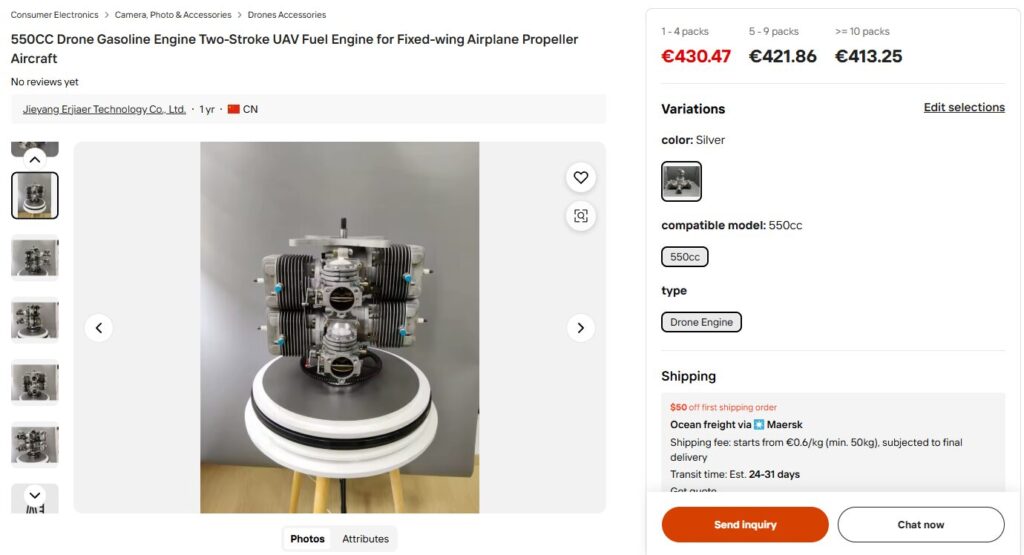
The motor can be found on Alibaba with the query “550cc engine”, though the prices vary significantly and I don’t know enough about buying engines and what engines cost to tell you whether this cost is realistic or a scam. The prices seem to vary from 400 to 8000$, and online, articles quote the engine as being 17000$. These are some examples of what these cost:

The servos are also easily found on Alibaba:
I can’t comment on the warhead because I don’t know anything about warhead economics or construction. It explodes and probably costs a few hundred?
What’s notable here is that the electronics themselves are cheap, but the drone also is – this is why there have been some notable omissions of components (like the engine starter). I believe that this indicates that the cost pressure is real, but there are many factors that go into the whole thing, and that qualifying replacements is also a significant cost, so they’re somewhat trapped. The margin probably isn’t that high if they’re selling them for 30-35k.
Sanctions Discussion
The BoM and design show the complex effects of sanctions. Notably, the fact that sanctions have hurt Russia in terms of parts availability and have reportedly led to production stoppages. This is undeniably good – every Geran delayed or prevented is a family that survives, a bus that reaches its destination, and a soldier that gets to keep fighting. For a few essential years, sanctions have hurt a lot. However, it is undeniable that the trends are shifting and Russia seems to be using more and more domestic or Chinese components. The Izdelie-30 cruise missile is notable because it has many more Russian components, including the microcontroller, a few transceivers, and the navigation. This is much harder to sanction and shut down. As the war continues, these will probably increase in frequency and quantity, at which point sanctions become less effective than just… fighting the war.
My personal belief is that the same effects that show when sanctioning China (like the STM32 example above) don’t show with Russia because the Russian system is not one that’s set up to promote competence and excellence as much as the Chinese one. When China gets sanctioned, they remake that industry based on where they last had access to foreign technology. When Russia is sanctioned, they have neither the economic nor brain capacity to do so, so they reduce their battlefield/economic capabilities instead. Russia survives, China thrives. This is why sanctions work well on Russia, and continuing them is beneficial to those fighting Russia. However, their effectiveness will keep decreasing, and eventually someone has to pick up a rifle and shoot it.
Structural Analysis
I study Aerospace Engineering, so I can also shed some light on this one. The configuration is a standard cropped delta wing. The wing extends almost the whole length of the fuselage, with the fuselage basically being a thicker center section of the wing instead of a separate body. This is a modern blended wing-body (BWB) design. The cruise speed is ~180km/h, wingspan is 2.5m, length is 3.5m, takeoff weight is ~200kg. There is a propeller at the very tail driven directly by the MD-550 engine. There are two vertical stabilizers that extend up and down from the wingtips which provide yaw stability and reduce induced drag.
The delta wing is the correct approach in this context with caveats similar to those in the electronics discussion. Tailless delta wing drones are aerodynamically worse than conventional drones – they have higher cruise drag, worse stall behavior, and less efficient pitch control because the elevons must do both elevator and aileron duty, and they have a lower lift-to-drag ratio than a conventional high-aspect-ratio wing. However, the reasons why it works in this context are:
- Manufacturing simplicity – a cropped delta has straight leading and trailing edges with no separate horizontal tail. The tooling and parts are far simpler.
- Volumetric efficiency – the thick wing-body has internal volume for fluid tanks that are built into the wings, removing the need for a separate fuselage tank structure.
- Center-of-gravity tolerance – tailless deltas have elevons with a wider acceptable range of centers of gravity than conventional configurations, which matters when warhead size or fuel state varies. This is also what allowed Russian manufacturers to add the advanced antenna, add a bigger warhead, move the flight computer in the opposite section, and even put a whole rocket launcher on top.
The drone is paying a ~20% penalty in range in exchange for manufacturing simplicity and packaging volume. For a 30k one-way drone, this is probably the right choice.
Airframe Construction
The airframe is made of fiberglass-reinforced plastic over a foam core. There is some localized hardpoint reinforcement using carbon fiber or aluminium, from what I can tell. This is basically the same way hobby RC aircraft or surfboards or small boats are manufactured.
The wing structure is a foam-core sandwich – two skins of fiberglass are wet-laid with epoxy resin around a foam core. The skins carry bending and torsional loads, while the foam core provides shear connection and shape. It’s light and stiff – good enough. The fuselage is the same, probably with some internal reinforcement. Apparently, the newer Russian versions use carbon-fiber instead – it’s more expensive, but makes the structure stronger and lighter. Nothing special here – the drone is standard.
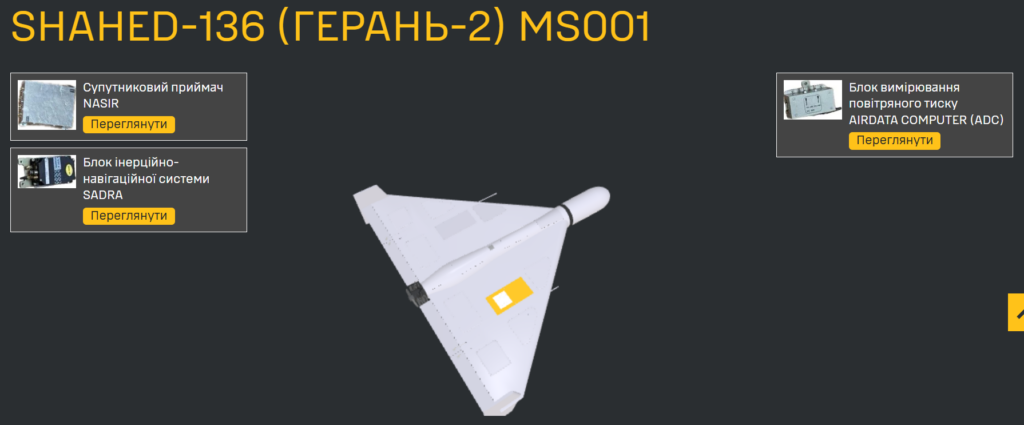
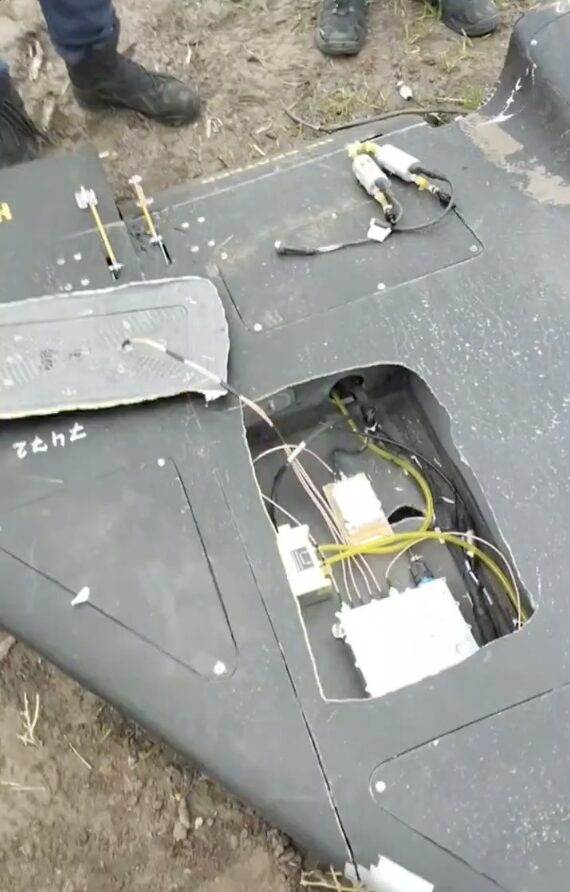
The wings additionally house many of the added components. The INS/IMU, air-data computer, SADRA navigation system, and mission-specific additional modules like video transmitters are placed in the wings inside of the compartments as such:
The Engine
The MD-550 was specifically designed to drive a propeller without a gearbox, making the whole drone lighter and removing cost and failure modes. The engine is air-cooled and fed by air through the fuselage. There is no oil cooler because the engine has no oil – oil is mixed with fuel, burned in the combustion process. Again, a significant simplification.
At launch, the drone is put on an angled rail with a rocket at the bottom of the fuselage. The rocket fires for 1-2 seconds, carrying the drone up to ~50m/s, then the rocket stops, the drone drops the rocket, and the engine takes over.
Control Surfaces
There are two elevons on the wing trailing edges with (combined elevator + aileron, moving together gives pitch, moving differentially gives roll), and two rudders on the wingtip vertical stabilizers for yaw. Each is driven by one of the four servos. This is a significant cost advantage, as the control system has only four actuators, compared to a conventional UAV which can have many more.
Manufacturing
The construction quality looks crude by aerospace standards. In many photos and teardowns, the fiber laying is imperfect, there are gel coat runs, uneven pain, exposed fastener heads, fillets appear hand-made rather than with tooling – but it’s also logical why this is. The drone flies relatively slowly, one-way, and it needs to explode once. It doesn’t need pressurization or to care about cyclical failure. The extremely high standards for commercial aviation or even traditional UAVs don’t apply here.
The composite construction is labor-intensive but not skill-intensive. The fiberglass layup is pretty easy to learn, even if you’re a kid. Hobbyists routinely do it by hand. I’ve seen it at my university. They’re probably inspected once and passed/rejected. The materials are simple and cheap. Additionally, this makes modification trivial. You just need to cut a hole, put stuff, then cover the hole. Something that would take immense reworking and recertifying in a conventional design is something you can put on an IKEA-style manual here.
Also note that there are major production differences between the Iranian and Russian versions. Generally, the Russian versions, especially the new ones, have adopted better technologies. The Iranian drones use a honeycomb 3D-printed internal structure instead of foam. This is interesting, but ultimately replacing it with foam is likely the right call.
The information in this section was taken from the following sources:
1. The Shahed Drone – Takshashila Institution
2. Shahed-131 & -136 UAVs: a visual guide – Open Source Munitions Portal
3. Shahed-136 (ГЕРАНЬ-2) MS001
Conclusion
The Geran follows the spiritual design philosophy of the T-34 tank. It’s not the best, it’s not the cheapest, but within the given limitations, it’s a good design. The war has seen many one-off designs on both sides that promised a lot, but couldn’t deliver much due to these exact limitations. The Geran isn’t good because the design is sophisticated and optimized – it’s good because they can make a lot of them, make them affordably, and get their people to use them to devastating effect, while under heavy economic, demographic, and military pressure. I think that this is why the Geran/Shahed is so attractive as to make the US copy it too. Recent reports indicate that the design is already being upgraded in many aspects, and will likely continue to get more advanced. Don’t overestimate the Geran, and don’t underestimate it – understand it. It has many strengths, it has many weaknesses, and those change widely depending on the context and the phase of the war. Understand that military equipment is much more than just numbers on a news article.
